
Curtains Basel
Consultation and custom-made curtains
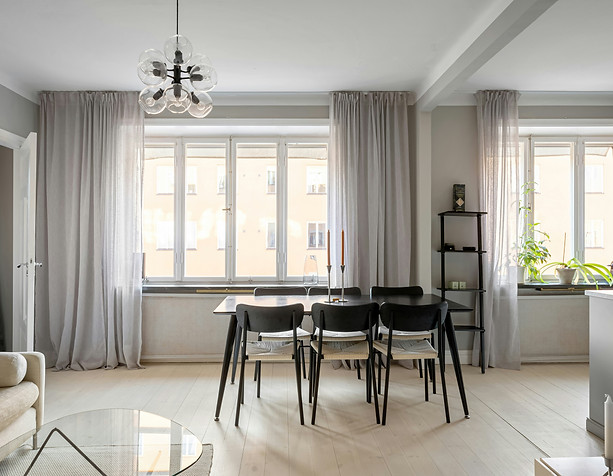
Curtains influence a room far more than is immediately apparent. They regulate light and privacy, improve acoustics, create a sense of seclusion, and shape the atmosphere of a room. Color, material, transparency, and drape determine whether a room appears calm and sophisticated or restless and unfinished.
As an interior design firm in Basel, we therefore do not view curtains as isolated window decorations. We integrate them into the overall interior design concept and coordinate fabrics, colors, and curtain systems with the architecture, furnishings, lighting, and use of the room.
INBYKO accompanies you on your curtain consultation in Basel, from the initial idea through fabric selection and planning to the perfect implementation. We develop custom-made curtains that are both functional and aesthetically suited to your rooms.

How much do custom-made curtains cost?
The price of a curtain depends on several factors. Particularly relevant are the length of the curtain track, the room height, the desired amount of fabric, the chosen fabric, and the type of construction.
To give you an initial overview before a consultation, you can use our curtain cost calculator here.
This calculation serves as a first guide. The actual price depends on factors such as fabric quality, quantity of fabric, room height, pleat pattern, tailoring, curtain system, and installation situation.

CONTACT
This isthe fastest wayto sendyourrequest for new curtains to your home .
Our curtain consultation in Basel
Our curtain consultation is part of our interior design and furnishing advice.
The following process takes place:
1. Analyze the space
We consider architecture, light, windows, furnishings and usage.
2. Define the function
Do you need privacy, blackout, acoustics, or primarily a design enhancement?
3. Define mass
Windows, room height and curtain tracks are taken into account.
4. Select fabrics
Together we will select suitable materials, colors and fabric qualities.
6. Determine costs
The investment can be specified more precisely based on the chosen materials and required linear meters.
7. Implementation
The planned solution will be assembled and mounted and hung according to the agreed curtain system.
Which curtain is suitable for which room?
Not every curtain has to fulfill the same function.
Depending on how a room is used, different solutions may be appropriate.
day curtains
Day curtains create privacy without completely blocking out daylight.
They are particularly suitable for:
-
Living room
-
Dining areas
-
bedroom
-
Apartments with direct views
-
large window areas
Lightweight fabrics create a soft lighting atmosphere and can reduce harsh contrasts between the window and the interior.
Night curtains
Night curtains are denser and provide greater privacy. They can also enhance the ambiance of a room and lend a more tranquil atmosphere to large living spaces.
Stronger blackout curtains can be useful in the bedroom. Here, the interplay of fabric, side light, and curtain track must be considered during the planning phase.


Linen, cotton or polyester – which curtain fabric is suitable?
The choice of material not only affects the appearance of a curtain, but also its drape, care, light transmission and long-term behavior.
polyester curtains
Polyester is often underestimated. High-quality, modern polyester fabrics can be visually very sophisticated while also offering functional advantages.
-
good dimensional stability
-
very easy to care for
-
even folds
-
large selection of structures
-
different levels of transparency
Polyester is therefore suitable for both private homes and rooms where care and dimensional stability play an important role.
Is polyester of lower quality than linen?
Not necessarily. The quality of a curtain fabric doesn't depend solely on the fiber. Crucial factors include the weave, workmanship, weight, feel, and the desired function.
A high-quality polyester fabric may be a better solution for a particular room than a natural fabric.
Alternative curtain fabrics:
Linen curtains
Linen has a natural, characteristic structure and appears particularly high-quality and timeless.
The fabric goes well with:
-
natural materials
-
wood / stone
-
restrained color schemes
-
modern and classic apartments
Linen is intentionally designed with an imperfect, uneven appearance. Minor irregularities are part of the material's character and create a vibrant surface. Linen can create a calm and natural atmosphere, especially in living and dining areas. However, as a natural fiber, linen reacts more strongly to moisture and climatic changes than synthetic fabrics. This must be taken into account when planning, determining the length, and caring for linen.
cotton curtains
Cotton has a soft and pleasant textile feel. Depending on the weave, it can appear very light or significantly denser.
-
Living room
-
bedroom
-
Family apartments
-
natural interior design concepts
It combines well with wood, natural stone and other textile materials.
It should also be taken into account that cotton is a natural fiber that can change under certain conditions.
Why professional curtain design?
A curtain is not just made of a beautiful fabric. For it to function properly in a room, various factors must be coordinated.
Especially in rooms with large windows or open-plan living areas, curtains can have a decisive influence on the overall feel of the room. Professional curtain planning therefore always considers the entire room, not just the window.
-
Window width and room height
-
desired privacy screen
-
Daylight
-
Sunlight
-
Acoustics
-
Spatial proportions
-
color and material
-
Curtain tracks
-
Folds and amount of fabric
-
Cleaning and care

Fragen & Antworten